Implicit condition for deriving the eccentric Circle
 Andrew Henderson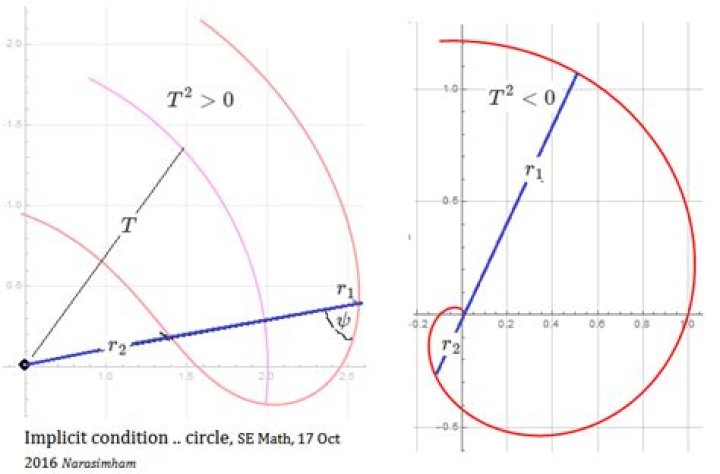
Line segments $r_1, r_2$ starting from a common origin (either overlapping on same side, or placed opposite sides of origin) have a constant product $ =\pm T^2$ by rotation of the entire common line about origin as pole.
What condition was implied by Euclid in geometric configuration/setting so we add it (plug it in) to derive equation of a Circle ?
EDIT 1:
Any number of curves can be constructed to have a constant geometric mean of radial segments.
To illustrate what I mean instead of a circle I am taking a simple example of a "returning" curve (tangent going through origin) as:
$$ r^2 - a^2 \psi = T^2 = r_1 \cdot r_2 \tag{1} $$
where $r_1,r_2 $ reach up to the curve from origin at same $ \theta$ , $ \psi $ is angle between radius vector and arc tangent. Differentiate with respect to arc, using $ dr/ds = \cos \psi,$
$$ \psi^{\prime} = 2 r \cos \psi/a^2 ;\quad \psi^{\prime \prime}= \cos \psi ^2 - r \sin \psi \cdot \psi^{\prime}\tag{2} $$
$ \psi $ is angle between radius vector and arc tangent
Taking constants $ a=1, T= 2 $ and corresponding boundary conditions when we integrate last second order ODE as $ \theta =0, r_i= \sqrt 6, \psi_i= 1$, the desired curve appears as follows with
$$r_1 \cdot r_2 = T^2 \tag{3} $$ everywhere:
EDIT2:
The curve for case $$ T^2 < 0 , \,T^2 = -1.6, \, a=1,\,\theta_i=0, \,r_i=1,\, \psi_i = 1.3 \,rad \tag{4} $$
turns out to be a non-recursive spiral, added below.
EDIT 3:
The ODE of a standard eccentric circle radius $a$ is given by
$$ \frac{\sin \psi} {r} = \frac{1}{2a} (1-\frac{T^2}{r^2}) \tag{5} $$
In order to investigate further what Euclid may have implied and to investigate further the behavior at nose of curve $T= 2$ ( green curve), I have next taken a changed "linear" ODE in the following form:
$$ \frac{\psi_k} {r_k} = \frac{1}{2a} (1 -\frac{T_k^2}{r_k^2}) \tag{6}$$
They all have same power $ \pm T^2$ periodic with $2 \pi a $ radial width.
and obtained a $(k)$ series of concentric "eel" shaped curves of constant width $ 2 \pi a$ between two concentric circles for positive power $T^2$(red). For negative power, $-T^2$ (blue) the curve behavior is similar but how extreme radii values form are still not clear.